

In Vienna, Virginia, children have opportunities to notice science and engineering in everyday life, from measuring rainfall after a summer storm to designing a shade structure for a backyard or park. A local STEM education center can complement learning at home and at school by giving children time to explore questions through building, testing, coding, and observation.
The most meaningful STEM experiences do not need to feel like extra homework. They begin with a challenge a child can see, touch, and change. When children use ordinary materials to investigate an idea, they practice habits that are useful in classrooms, friendships, and future work: curiosity, persistence, communication, and thoughtful decision-making.
Why Hands-On STEM Works
Hands-on learning turns an abstract idea into something children can investigate. A lesson about forces becomes clearer when a student folds paper into different shapes and tests which paper bridge can hold the most coins. A lesson about measurement becomes practical when a child compares plant growth, records daily temperatures, or calculates how far a balloon-powered car travels.
Unlike passive memorization, a project asks children to make a prediction, observe what happens, and explain the evidence. They are participants rather than spectators. Current examples of hands-on STEM education work also show how modular tools, laboratory activities, and real questions can make learning more concrete for students.
Skills Children Build Through STEM Projects
STEM projects are not only about preparing for a particular career. Repeated practice can help children develop everyday skills that apply across subjects and situations.
- Problem-solving: Children identify a challenge, consider options, and test a possible solution.
- Critical thinking: They compare results and use evidence to decide what may have affected an outcome.
- Communication: Partners need to share ideas, listen carefully, and explain their reasoning.
- Planning: Projects encourage students to gather materials, sequence steps, and manage time.
- Creativity: An open-ended design challenge can have several workable solutions.
- Patience: Children learn that a first attempt is information, not a final judgment of their ability.
Age-Appropriate Activity Ideas
Early Elementary Students
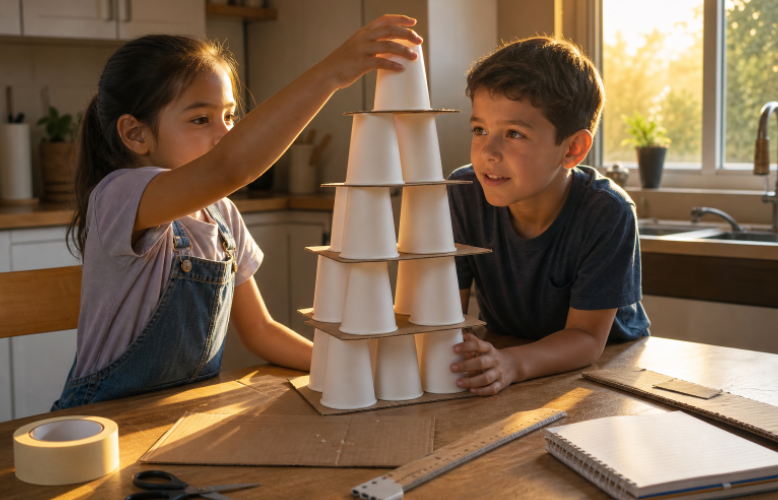
Young children often respond well to short, visual challenges. They can build the tallest tower possible from paper cups, sort household objects by texture or weight, make a simple water filter with adult supervision, or track a seedling’s growth with drawings and measurements.
Upper Elementary Students
Older elementary students can take on more structured testing. Try a balloon-powered car, a bridge made from index cards, a block-based coding animation, or a shadow investigation that compares the length and direction of shadows during the day.
Middle And High School Students
Teens may enjoy projects tied to practical concerns. They can program a sensor or small robot, compare electricity use listed on household devices, collect and graph local observations, or propose a design that addresses a need at school or in the Vienna community.
The Role Of Failure And Revision
A bridge that collapses or a program that does not run as expected can be one of the most valuable parts of a project. The result gives the child information. Perhaps the bridge needed a wider base, the tape was placed poorly, or the code instructions were in the wrong order.
Adults can keep the focus productive by asking, “What did you notice?” or “What would you change next?” Those questions invite analysis without making the child feel judged. Engineers, scientists, and programmers routinely revise their work. Children gain more from this process when adults offer support without taking over the design.
Simple Ways To Add STEM At Home
- Start with one question. Ask which item will float, bend, roll farther, or absorb more water.
- Use safe, low-cost materials. Cardboard, tape, cups, string, recycled containers, rulers, and paper are enough for many challenges.
- Ask for a prediction. Let the child explain what they think will happen before testing begins.
- Record the result. Use a drawing, a photo, a chart, or a few written observations.
- Change one factor. Adjust the height, weight, material, shape, or timing, then test again.
- Discuss the evidence. End by asking what the child would try in another round.
How To Choose A STEM Learning Program
For Vienna families considering an after-school club, camp, tutoring option, or enrichment program, look beyond the label. A strong program gives students meaningful choices while providing clear structure and age-appropriate guidance.
- Look for real experiments, design challenges, or coding tasks rather than worksheets alone.
- Ask whether activities can be adjusted for different ages and experience levels.
- Choose instructors who encourage questions and help students reason through obstacles.
- Confirm that safety expectations are clear for every activity.
- Ask to see example projects, learning goals, or the balance of science, engineering, coding, and math.
Programs can be especially useful when they provide tools and collaborative projects that may be difficult to arrange at home. One example of how hands-on laboratory experiences can extend learning comes from school-community partnerships that share equipment, teaching support, and inquiry-based activities.
Questions Parents Often Ask
Does A Child Need To Be Good At Math To Enjoy STEM?
No. Many projects start with observing, building, and asking questions. Math becomes relevant as children count, measure, compare, and organize results.
How Much Time Does A STEM Activity Need?
A useful activity can take 15 minutes or continue over several days. Short challenges often suit younger children, while older students may want time to refine a larger design.
Should Adults Give The Correct Answer?
Guiding questions are usually more helpful than quick answers. Ask what the child expected, what happened, and what change might be worth testing.
What If A Child Loses Interest?
Change the format or the real-world connection. A child who dislikes writing about a science idea may enjoy building a model, drawing observations, or coding an animation about it.
Final Thoughts
Lasting STEM learning in Vienna does not depend on expensive equipment or advanced lessons. It grows when children have room to investigate, make choices, explain what they see, and try again. Whether the project happens at a kitchen table, in a classroom, or during an enrichment program, curiosity is the starting point, and revision is part of the learning.